Pool contractor Google Ads
Pool Google Ads Negative Keywords: What to Exclude
A practical way to filter job seekers, DIY searches, and services you do not sell—without blocking homeowners who want a pool estimate.
Short answer: add negatives for searches that cannot become the kind of pool project you sell, then review real search terms regularly. A custom inground builder might exclude “jobs” and “above ground pool kits,” but should not automatically exclude “pool cost,” “free estimate,” or “pool repair.” Those decisions depend on your services, campaign, and landing page.
When a pool builder pays for a click, the question is not whether the search contains the word “pool.” It is whether the person could plausibly become a customer for that campaign. Negative keywords help prevent ads from showing for unwanted searches. They are one part of a wider pool contractor marketing path: the right search, a credible service page, a clear estimate request, and a real follow-up process.
Start with your actual service menu
Write down what the ad campaign is supposed to sell before building a negative list. A new-construction campaign, remodel campaign, and equipment-repair campaign may need different exclusions. If you do both builds and repairs, an irrelevant query for the build campaign may still be valuable for the repair campaign.
For example, a custom inground pool builder who does not sell portable or above-ground kits can usually exclude kit-shopping searches from a new-build campaign. A remodeler who services existing pools should be more careful with “pool repair.” Broad account-level exclusions could hide that business everywhere.
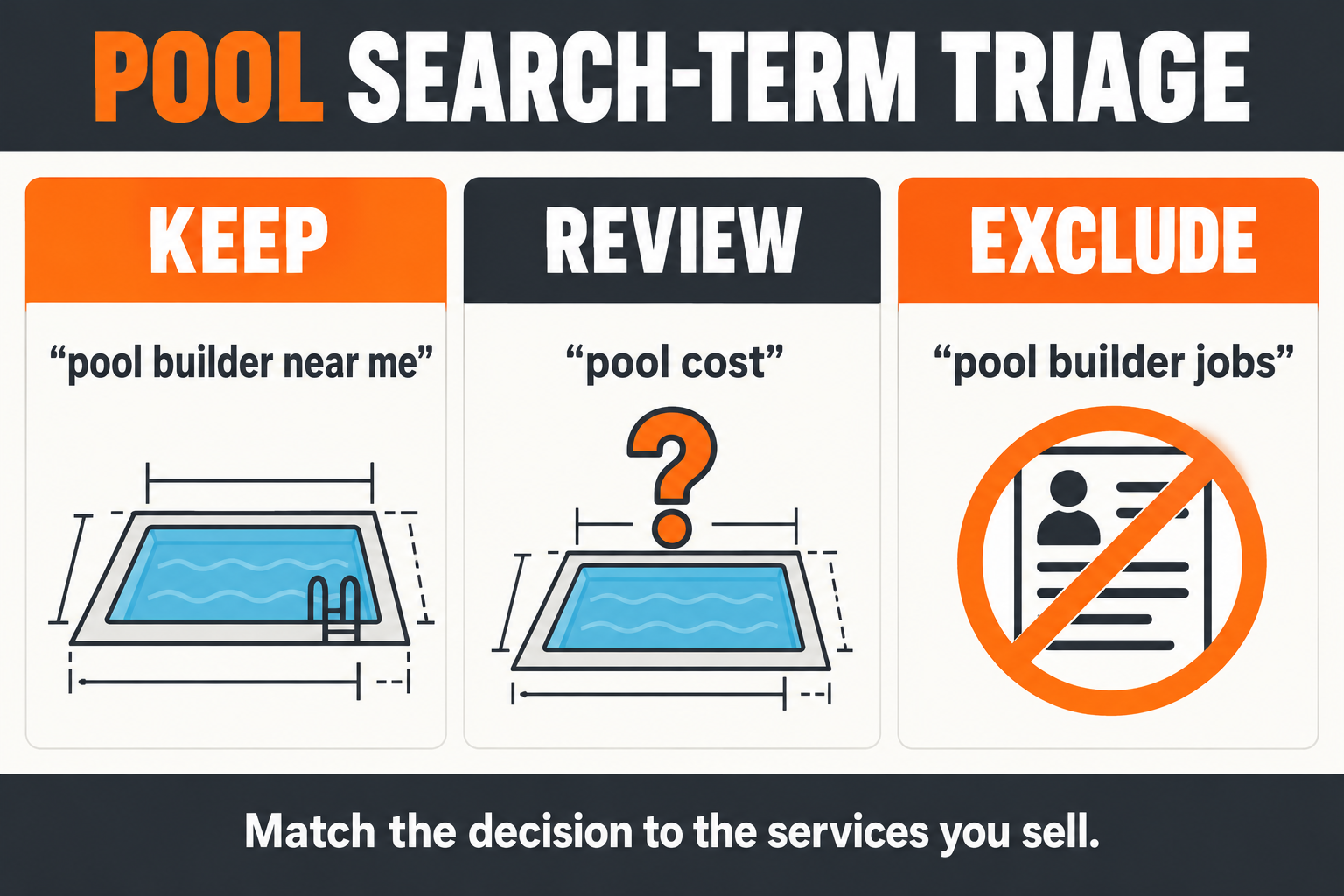
Which pool searches should you keep, review, or exclude?
| Search term | Starting decision | Why |
|---|---|---|
| pool builder near me | Keep | Strong new-build intent if you serve the searcher’s area and your ad leads to a relevant build page. |
| pool cost | Review | Early research can still become a project. Check location, landing-page fit, actual leads, and cost before excluding. |
| pool builder jobs | Exclude | A hiring search is not a homeowner estimate request, unless this campaign is for recruiting. |
| above ground pool kits | Exclude if not sold | Exclude from custom inground campaigns if kits or above-ground installations are outside your business. |
| pool repair near me | Campaign-specific | Exclude from a build-only campaign if appropriate; keep in a repair campaign if you offer repairs. |
| free pool estimate | Do not blanket-exclude | “Free” may describe a normal consultation, not a demand for a free pool. Check your actual offer and lead quality. |
These are examples, not a copy-and-paste list. “Jobs,” “DIY,” “kit,” “cleaning,” and “repair” can mean very different things depending on your business. If you sell pool cleaning, for instance, excluding “cleaning” across the account would cut off a real service.
A safer four-step negative-keyword workflow
1. Inspect actual terms
Use the Google Ads Search terms report to see searches that triggered ads. Look at the query, campaign, ad group, and match type together.
2. Classify the intent
Mark a term as relevant, uncertain, or clearly wrong for the campaign. Record why; do not exclude a whole theme after one ambiguous click.
3. Exclude narrowly
Choose the right negative match type and scope. A campaign-level exclusion is often safer than an account-wide one when another service could use the term.
Then 4. Recheck after the edit: review search terms, impressions, qualified inquiries, and landing-page behavior. If a negative removes useful demand, revise it. Google notes that the Search terms report does not show every low-volume query, so treat it as evidence—not a complete transcript of all searches. See Google’s Search terms report guidance.
Do not mistake a poor landing page for a bad search
If a search is relevant but produces no qualified requests, inspect the page and conversion path before blocking it. Does a “pool remodel” ad land on a generic homepage? Does the page show real project proof, the service area, and the next step? Is the pool estimate request form usable on a phone? A viable search can look wasteful when the page or follow-up is weak.
Cost matters too. Our separate contractor Google Ads budget guide helps set a test budget around economics rather than a generic spend rule. The free contractor estimate calculator can help you think through margin on the work you actually want to sell. Neither tool can replace measuring which inquiries become qualified appointments and sold projects.
Five-minute pool search-term audit
Check these before adding another negative. This is a local planning checklist; it does not connect to your ad account or send data.
0 of 5 checked.
Your checks remain in this browser only.
Frequently asked questions
Should pool builders exclude “free”?
Not automatically. A homeowner may be searching for a free estimate or consultation, which may match your offer. Review the complete query and lead quality first. Exclude only clearly unwanted meanings.
Can I use one negative list for builds and repairs?
Use shared exclusions for truly irrelevant intent, such as recruiting searches in a customer-acquisition account. Keep service-specific exclusions at the relevant campaign or ad-group scope so a repair campaign can still reach repair searches.
How often should I review search terms?
Review more closely when a campaign is new or changing, then use a repeatable cadence tied to spend and lead volume. There is no universal frequency; the point is to catch waste without reacting to every isolated click.
Will negative keywords fix low-quality leads by themselves?
No. They can reduce some irrelevant impressions and clicks, but geography, ad message, service-page clarity, form design, response speed, and tracking also affect lead quality.
Make your pool ad spend easier to defend
Matt’s Marketing Express can review the search terms, service-page fit, and estimate-request path together. Our Google Ads management for contractors includes search-term and negative-keyword work, while the free review identifies the most useful next step for your business.
Get a free contractor marketing review