
Painting contractor Google Ads
Painting Contractor Google Ads Landing Page: What to Include
A page-by-page checklist for turning a relevant painting search into a real estimate conversation, without promising an instant quote your crew cannot deliver.
Short answer: send each painting ad to a page that matches its service and location, shows authentic work, explains what happens next, and makes a mobile estimate request simple. Measure qualified estimate opportunities, not just button clicks. If your ad says “interior painting,” a generic homepage or exterior-only gallery makes the homeowner do the work of figuring out whether you fit.
A painting landing page is the destination after an ad click, not a replacement for a complete website. The painting contractor marketing page describes the broader path from trust to estimate to follow-up. This guide narrows in on the paid-search handoff: what the homeowner expects after the click, what to show first, and how to test whether the page earns a useful inquiry. Google describes landing-page experience in terms of relevant, useful information and an easy path for the visitor; see its landing-page explanation.
Match the page to the exact painting promise in the ad
Start with one campaign promise, then make the first screen answer it. A homeowner searching for cabinet refinishing may not be ready to sort through exterior painting, drywall repair, and whole-house repainting before seeing cabinet work. You do not need a unique page for every keyword, but you may need separate destinations for meaningfully different services.
An illustrative interior-painting match
That example is a pattern, not an MME client campaign or a promise of results. Replace the city and service with the places and jobs your company actually serves. If the ad targets exterior painting, the page should lead with exterior work, weather and prep considerations, and exterior examples. Google advises that the page match the ad and keywords and mirror the ad’s call to action; see its landing-page guidance.
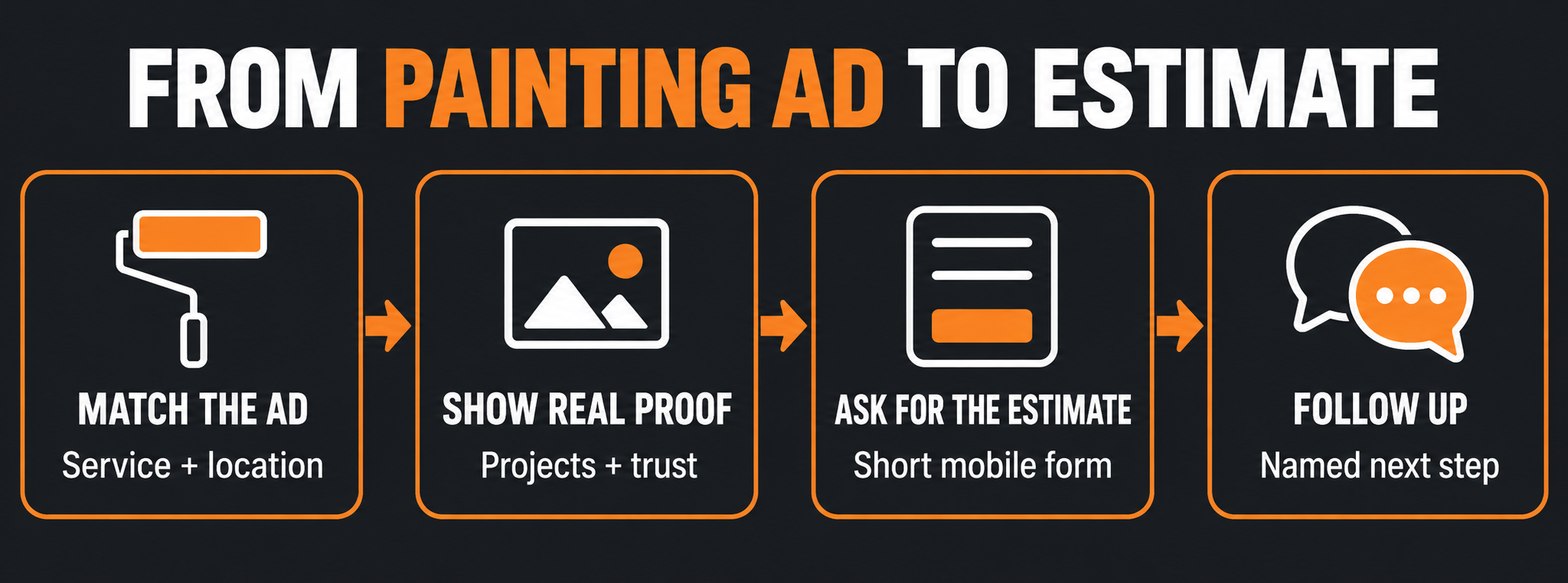
Give homeowners enough proof to choose a walkthrough
Project photos with context
Show your own completed work with permission. Name the service and broad scope in a caption: for example, “occupied living room repaint with trim protection.” Avoid passing off an illustrative image as a client result.
Process and fit
Briefly explain preparation, protection, communication, and cleanup. State the service area and whether you handle interiors, exteriors, cabinets, or commercial work so the wrong visitor can self-select out.
Trust signals you can substantiate
Use real review excerpts, licensing or insurance information when applicable and current, and a clear business identity. Do not invent ratings, awards, job counts, or “same-day” capacity.
A clear estimate step
Tell the homeowner whether they are asking for a phone call, site visit, or preliminary conversation. A short form should not imply a firm painting quote without seeing the surfaces and scope.
Your Google Business Profile painting photos can reinforce the same real project story, but the ad page should still show the proof a visitor needs without making them leave the site to investigate.
Build the form for a phone, not a desktop questionnaire
A first-contact form can ask for name, one reliable reply method, ZIP or city, the painting service, rough timing, and an optional project note. Photos may help with existing surfaces, but make uploads optional so a mobile visitor can still ask for a walkthrough. If you collect both phone and email, let the person choose a preferred contact method. Do not require exact room measurements, paint colors, or a firm budget just to start the conversation.
Show what happens after submission. For example: “We’ll review your project details and contact you to discuss a walkthrough.” Only add a response window if your team can consistently meet it. Route the inquiry to a named owner and test the confirmation, notification, and backup path. A form that submits but sits unanswered is not a working lead system.
Measure the complete estimate opportunity
Track more than the page load. Check whether the form submits successfully, phone links work on mobile, and the thank-you step is recorded. Google Ads supports website conversion measurement for actions such as form submissions and calls; its web-conversion setup guidance explains the options. Test with your own submissions before using the numbers to judge a campaign.
Then classify the inquiries: wrong service, outside area, qualified walkthrough, estimate sent, and sold project. A low click cost is not success if the work is unprofitable or the page attracts jobs you do not perform. Conversely, a page may need better proof or follow-up before you conclude the search itself is bad. Use the separate contractor Google Ads budget guide to frame a test budget around business economics rather than a generic monthly number.
Five-point painting ad-page check
Use this as a planning aid for one ad destination. Nothing is sent to MME or your ad account.
0 of 5 checked.
Your checks stay in this browser only.
Frequently asked questions
Should every painting ad go to a separate page?
No. Group ads that promise the same service and fit the same page. Create separate destinations when the intent differs enough that one page would make the visitor hunt—for example, cabinets versus exterior house painting.
Should the landing page remove all navigation?
Not automatically. The page should make the estimate step obvious and minimize distractions, but visitors may reasonably want to verify your company, service area, and work. Test whether navigation helps trust rather than following a blanket rule.
Can I use stock photos on a painting ad page?
Use them only as clearly illustrative support. Real, permissioned project photos are stronger evidence of your work. Do not imply an illustrative photo is a completed client job.
What counts as a useful conversion?
A completed form or a connected call is a starting signal. For a painting business, the more useful question is whether the inquiry fits your service area and scope and becomes a real estimate opportunity.
Find the weak handoff in your painting ads
Matt’s Marketing Express can review the ad promise, landing page, estimate request, and follow-up as one path. Our Google Ads management service covers the campaign and measurement side; the $297/month Contractor Growth System on the painting marketing page provides the website and follow-up foundation. Start with a review of the path you have.
Get a free contractor marketing review