Contractor lead follow-up
How Fast Should Contractors Respond to New Leads?
A practical first-15-minute response plan for turning calls and form submissions into real estimate conversations—without living on your phone.
Short answer: respond as soon as you reasonably can. During business hours, aim to acknowledge a new contractor lead within 15 minutes, then move the homeowner toward a short qualifying conversation. If you cannot personally answer, an automatic text or email can confirm that the request arrived—but it should never pretend to be the full sales conversation.
A homeowner requesting an estimate is often contacting more than one company. The first contractor to respond does not automatically win, but a prompt, useful reply proves that the business is organized and gives the homeowner a clear next step while the project is still top of mind.
The goal is not to quote every job instantly. The goal is to acknowledge the inquiry, collect the minimum information needed, and schedule the right next conversation.
Why contractor response time matters
Contractor leads arrive in inconvenient moments: while you are driving, measuring a project, managing a crew, or speaking with another customer. That makes delay understandable. To the homeowner, however, silence can feel like uncertainty.
A fast response helps in three ways:
- It confirms the form or call worked. The homeowner does not have to wonder whether the request disappeared.
- It establishes professionalism. Clear communication before the estimate creates confidence about communication during the project.
- It creates momentum. You can ask the next useful question before the homeowner moves on to another company.
Speed alone is not enough. A vague “Thanks, we’ll be in touch” message can still stall the lead. The strongest response pairs speed with a specific next step.
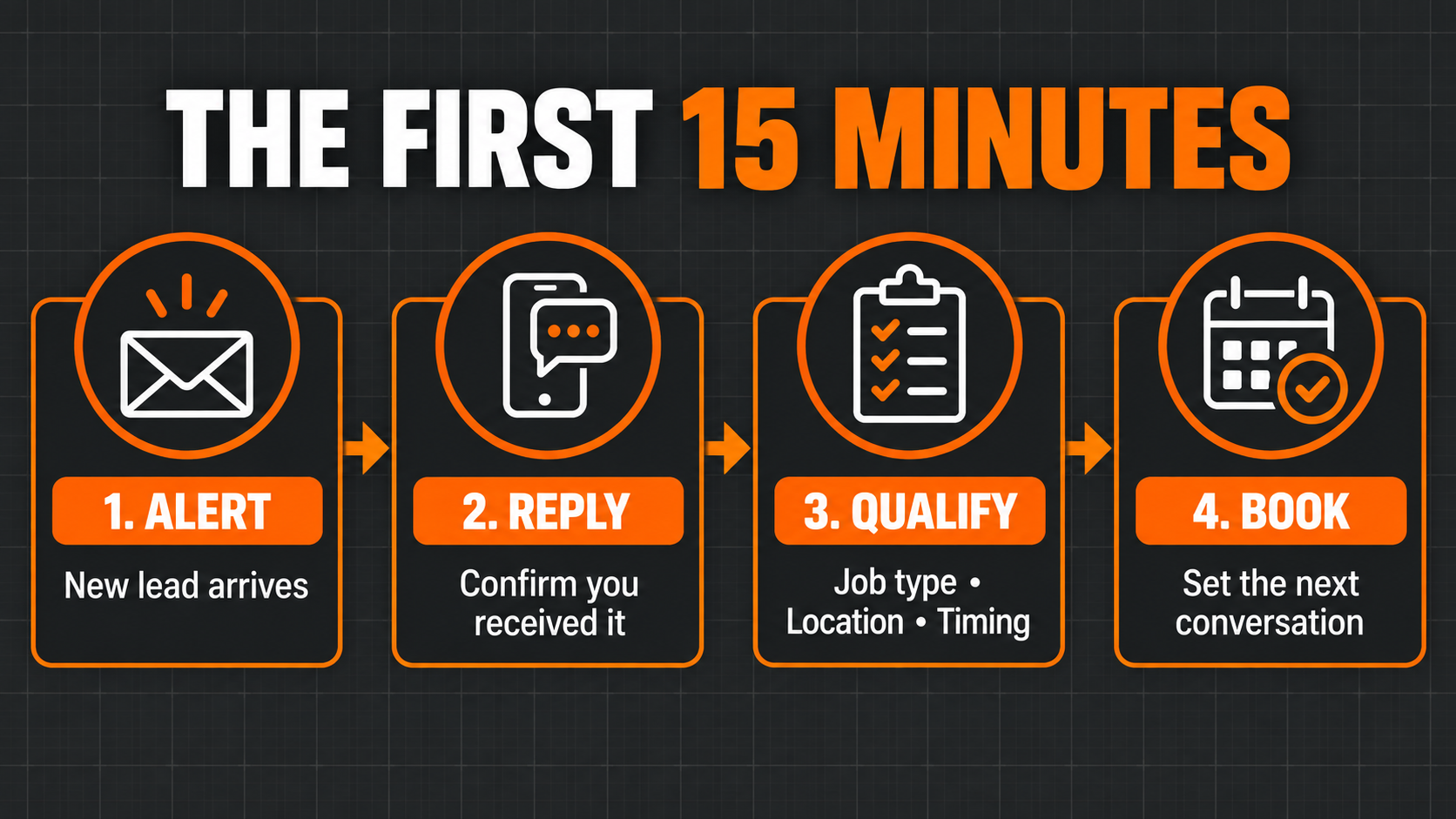
The first-15-minute contractor lead response plan
1. Get one reliable alert
Every website form, missed call, and advertising lead should create a clear notification. Avoid a setup that requires you to check several inboxes. Route new opportunities into one shared pipeline or inbox so a lead is visible even when the owner is unavailable.
2. Acknowledge the request
Your first message should confirm receipt and explain what happens next. Keep it human and specific:
Example first response
“Hi Jamie, this is Matt from Example Painting. I received your request about the exterior project in La Mesa. I’m finishing an appointment, but I can call you around 3:30 today. Does that work?”
This message identifies the business, references the project, and offers a real time. If the message is automatic, say so plainly: “We received your request. Matt will review it and reply by 3:30.” Honest automation is more trustworthy than a message designed to look manually typed.
3. Ask only the questions that change the next step
Do not turn the first reply into a 20-question intake form. Collect the information needed to decide whether the project fits and how to schedule it:
- What type of work is needed?
- Where is the property?
- When does the homeowner hope to start?
- Are there photos, plans, or measurements available?
- Who should be involved in the estimate conversation?
For pool builders, the early questions may cover new construction versus remodeling, access, and design stage. For painters, they may cover interior versus exterior, approximate size, surface condition, and occupied status. The questions should reflect the trade—not a generic script.
4. Book a defined next step
Finish the interaction with a scheduled action: a five-minute qualification call, a photo review, an onsite estimate, or a clear date when you will follow up. “I’ll call Tuesday at 10:00” is stronger than “Someone will reach out soon.”
If the project is ready for pricing, use a consistent estimating process. MME’s free contractor estimate and profit calculator can help you account for labor, materials, overhead, and target profit before presenting a number.
Recommended response targets by lead type
These are operating targets, not promises you must advertise. Choose standards your team can meet consistently.
| Lead type | Useful target | Best first action |
|---|---|---|
| Answered phone call | Immediate | Qualify briefly and schedule the next step. |
| Missed call during business hours | Acknowledge within 5 minutes; personal reply within 15 minutes when possible | Send an honest missed-call text, then call back. |
| Website estimate request | Acknowledge within 15 minutes | Reference the project and offer a call time. |
| After-hours inquiry | Immediate acknowledgement; personal follow-up early next business day | Set expectations and provide an emergency option only if you truly offer one. |
| Incomplete or low-detail lead | Same business day | Ask two or three qualifying questions before discarding it. |
What to automate—and what to keep human
Automation is useful when it removes dead time and administrative repetition. It becomes harmful when it creates a conversation the system cannot actually understand.
Good tasks to automate
- Confirming that a form or missed call was received
- Notifying the right salesperson or estimator
- Creating a lead record with source and timestamp
- Sending appointment confirmations and reminders
- Reminding your team when a lead has no next action
Keep these moments human
- Deciding whether the project fits your company
- Discussing budget, scope, site conditions, or tradeoffs
- Handling objections or homeowner concerns
- Explaining why your process or price is different
- Confirming the final estimate and next commitment
A practical contractor lead follow-up system should make the human conversation easier, not bury the homeowner in automated messages.
A simple follow-up cadence when the lead goes quiet
No response does not always mean no interest. The homeowner may be at work, collecting information, or waiting for another decision-maker. Use a short, respectful sequence:
- Day 0: acknowledge the inquiry and offer a next step.
- Day 1: send one useful follow-up question or propose two call times.
- Day 3: share a relevant preparation tip, project example, or checklist.
- Day 7: ask whether the project is still active and give permission to pause follow-up.
- Later: keep only genuinely opted-in prospects in longer-term educational follow-up.
Stop persistent outreach when someone declines, asks not to be contacted, or clearly does not fit your service area or scope. A clean pipeline is more useful than a large one filled with dead leads.
How to measure whether faster follow-up is working
Do not judge the process by response time alone. Track the path from inquiry to real opportunity:
- Median time to first acknowledgement
- Median time to personal response
- Percentage of new leads successfully contacted
- Percentage that become qualified estimate opportunities
- Estimate appointments booked, completed, and won
- Lead source for every won job
If response time improves but booked estimates do not, look at lead quality, the qualifying script, service-area fit, and how clearly your website sets expectations. More speed cannot repair the wrong offer or the wrong audience.
Frequently asked questions
Do contractors really need to respond within five minutes?
No universal deadline fits every contractor. Five minutes is a useful target for an acknowledgement, especially after a missed call. A consistent, personal response within 15 minutes during business hours is a more practical operating goal for many owner-led companies.
Should the first response be a text or a phone call?
Match the channel when possible. Return phone calls by phone, but a quick text can confirm that you saw a missed call and provide a callback time. For website forms, email or text can acknowledge the request before a short phone qualification.
What should an automatic missed-call text say?
Identify the company, acknowledge the missed call, set a response expectation, and ask one simple question. For example: “Thanks for calling Example Pools. We’re with a customer, but we received your call and will reply within 30 minutes. Is this about a new pool, a remodel, or service?”
How many times should a contractor follow up?
Use a small number of respectful attempts across more than one day, and make each message useful. Four touches over about a week is a reasonable starting point. Adjust based on project value, the homeowner’s stated timing, and consent.
Can a CRM replace a salesperson?
No. A CRM can route alerts, organize conversations, schedule reminders, and expose forgotten leads. A person still needs to qualify the project, understand the homeowner, and earn the next commitment.
Find where your estimate opportunities are getting stuck
If new contractor leads are arriving but too few become scheduled estimates, the leak may be response time, qualification, website clarity, or lead quality. Matt’s Marketing Express can review the path and identify the clearest next fix.
Request a free contractor marketing review